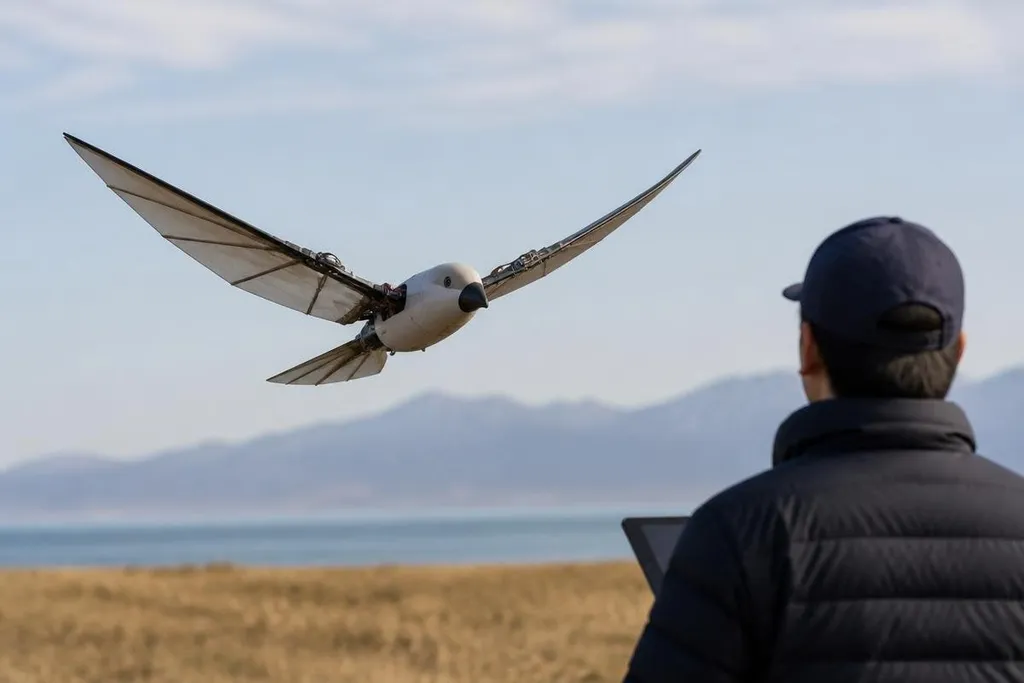
Birds solve flight with moving wings, small body adjustments, and careful landings. Robots that copy those parts can reach places that wheeled machines cannot, but their value depends on control, battery life, and the task they must perform.
- Flapping wings can help a small robot hover and change direction.
- Perching may save power when a flying robot needs to observe one place.
- Feathers, skin, and bird muscles still offer lessons that hardware cannot copy easily.
Why engineers look to birds
A bird changes its wing shape while it flies. The wing bends, twists, and changes its angle as the bird speeds up, slows down, or turns. A rigid fixed-wing aircraft can control flight too, but it uses a different set of movements.
That difference matters for small robots. At a small size, air does not behave exactly as it does around a large aircraft. A flapping wing can create lift during each stroke, then change its position for the next one.
The robot can use those strokes to move forward, turn, or hold its place. The body also matters because birds shift their weight while landing, climbing, and turning. A design with movable wings, a light frame, and sensors can copy part of that motion.
The control system then has to connect sensor readings to fast changes in wing position. This makes bird-like flight a control problem as much as a mechanical one.
Flapping flight has a cost
Flapping wings give a robot several ways to move, but the extra motion adds parts that can wear out or fail. Motors, joints, hinges, and flexible wing material must work together. A fault in one part can change the lift produced by the whole robot.
Power is another limit. A flying machine spends energy to stay in the air, even when it covers no distance. A bird can rest on a branch. Staying airborne requires a landing point, a perch, or a way to return to the ground without damage.
Perching changes that calculation. Once the robot reaches a suitable surface, it can stop flying and use its sensors from a fixed position. That can help with inspection or observation tasks where constant flight would waste the battery.
The landing step may be harder than the flight. A branch moves, a wall has an unknown surface, and a narrow ledge gives the robot little room for error. The gripper or foot must make contact, hold the load, and release it when the robot leaves.
What bird-like robots can do
The design fits tasks that need access from above, quiet movement, or a small body. A flying robot can pass over an obstacle, look down into a space, and leave without building a route through it. A perching robot can watch a location while using less power than a machine that keeps moving.
That does not make bird-shaped hardware the right choice for every job. A wheeled robot can carry more equipment for longer periods on a prepared surface. A multirotor can often change position without waiting for a wing stroke or a landing surface.
The useful question is the task. If the robot must cover ground, carry a heavy sensor, or work near people, another design may fit better. If it needs to enter a narrow space and pause on a surface, bird-like movement may earn its added mechanical cost.
A bird-like aircraft still needs evidence for flight time, sensor range, and autonomous control. Bird-inspired robotics reports from Robot24.com can connect those claims to named machines and recorded tests, so the next section can separate working parts from claims that remain unproven.
What remains unproven
A convincing flight video does not answer the practical questions. You still need to know how long the robot stays airborne, how often it lands successfully, what wind it can handle, and how much maintenance the wing system needs.
The same check applies to its software. The robot may follow a planned path in a controlled space, yet struggle when lighting, wind, or the landing surface changes. A useful system needs clear limits, repeatable behavior, and a safe response when its sensors disagree.
Bird biology offers good ideas, but copying the shape of a bird is the easy part. The hard work sits in the joints, power system, sensors, and control code.
A practical buying checklist
Before choosing a bird-inspired robot, check:
- Flight task: Does it need to hover, move forward, turn tightly, or land on a surface?
- Power plan: How long can it fly, and where will it land when the battery runs low?
- Wing system: Can the maker replace the motors, joints, and flexible wing parts?
- Sensor load: Does the robot carry the camera or sensor needed for the job?
- Test conditions: Has it been shown in wind, poor light, or changing landing spaces?
- Failure response: What does it do when it cannot find a safe place to land?
I'd skip a bird-shaped robot when the job only needs a small camera on a wheeled base. The flying design earns its cost when access, perching, or movement over obstacles matters more than load and runtime.
The next useful proof is simple: repeated flights, repeated landings, and clear battery figures under the conditions the robot is meant to face.